
Why 90% of Indian Crypto Trading Has Moved Offshore (And the Legal Way to Stay in India)

India leads the world in cryptocurrency adoption. For the third year in a row, we are number one on the Chainalysis Global Crypto Adoption Index. An estimated 119 million Indians hold crypto. And yet, when you look at where all this trading actually happens, something strange emerges. Nine out of ten rupees that Indians trade in crypto never touch an Indian exchange. Roughly 12 crore — that is 120 million — Indians use offshore platforms outside India’s regulatory reach. Over 180 Indian crypto startups have physically moved their operations abroad.
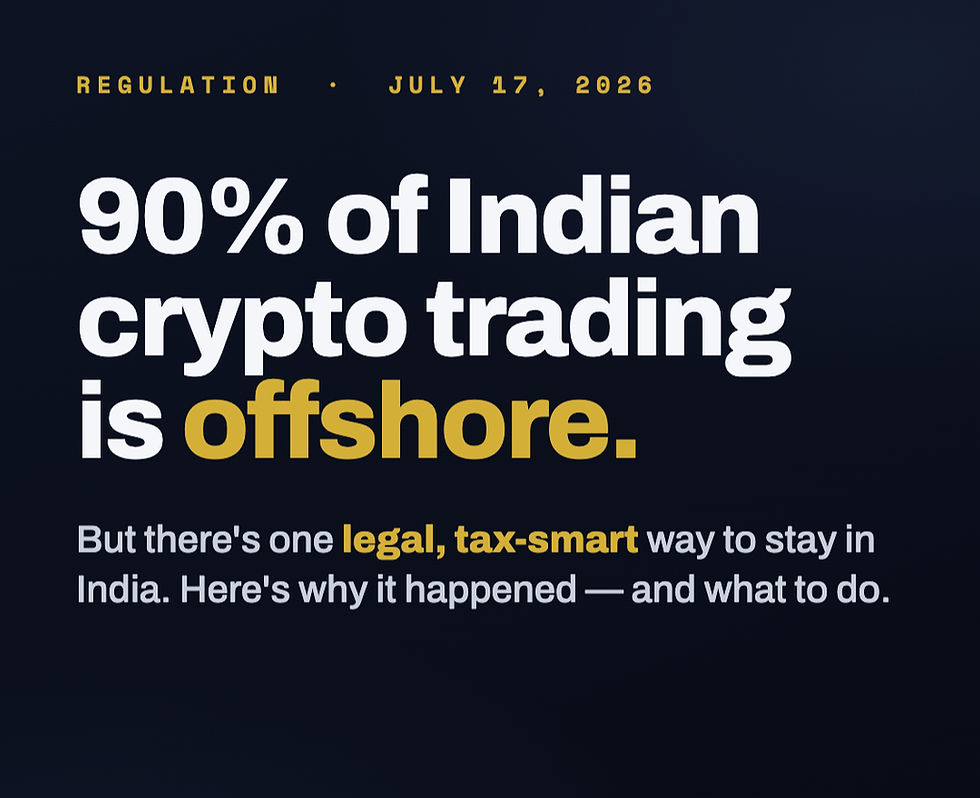
This is not because Indians love foreign exchanges. It is because our tax structure has made trading crypto on Indian platforms so expensive that offshore migration became the only way to trade profitably. This blog explains what really happened, the risks this creates for Indian traders, and the one legal, tax-efficient route that lets you stay in India — without breaking any law and without paying the punishing 30% VDA tax.
This is a follow-up to our recent blog on why RBI rejected crypto legalization. The two topics are connected. RBI wants crypto contained. The tax authorities want tax revenue. Indian traders, caught between the two, have voted with their feet.
The Reality in 30 Seconds About 90% of crypto trading volume by Indians happens on offshore platforms outside India’s tax and regulatory reach. Nearly 73% of VDA (Virtual Digital Asset) trading takes place on foreign exchanges, per MP Raghav Chadha’s Union Budget 2026-27 speech. Over 180 Indian crypto startups have physically moved abroad since the tax structure was introduced. The reason: 30% flat tax + 1% TDS + 18% GST + no loss offset = effective burden of 42-49% for active traders. Going offshore feels smart but carries real risks — legal exposure, no recourse if the exchange collapses, tax evasion penalties, and now FATCA/CRS data-sharing means the tax department can find you anyway. The legal escape route most Indian traders do not know about: INR-settled futures and options on Delta Exchange India are taxed at your normal income slab rate, not the flat 30% VDA rate. |
Indian Crypto Trading: What Offshore Migration Actually Means (In Simple Language)
When you open an account on Delta Exchange India, CoinDCX, or WazirX (before its restructuring), you are trading on an exchange registered in India with the Financial Intelligence Unit (FIU-IND). Your Rupee deposits go through Indian banks. Your KYC is Indian. Your profits are visible to the Indian Income Tax Department. This is called onshore trading.
When you instead open an account on Binance Global (not Binance India), Bybit, OKX, Bitget, or any of dozens of other exchanges based in Singapore, Dubai, the Cayman Islands, or Malta, you are trading offshore. Your account sits outside India’s regulatory framework. You typically fund it via a P2P (peer-to-peer) transfer with another Indian trader, or through a crypto deposit from a personal wallet. The Indian government does not directly see your account balance or your trading activity on that platform.
For the last four years, this offshore route has been the default choice for most active Indian crypto traders. The reason is not ideology. It is math.
Why the Math Pushed Traders Offshore (Explained With Real Numbers)
Let us walk through what the Indian crypto tax structure actually does to your profits. This example is simple but it is exactly what happens to real traders every day.
A Real Example: The Rs 1 Lakh Trade You buy Bitcoin worth Rs 1,00,000 on an Indian exchange. Rs 1,000 is deducted immediately as 1% TDS (Tax Deducted at Source) under Section 194S. You pay approximately Rs 300 as GST on the exchange’s trading fee (18% of the fee). A week later, BTC has moved up and your holding is worth Rs 1,25,000. You sell. Rs 1,250 is deducted as 1% TDS on the sell side. Your profit on paper: Rs 25,000. But then the 30% VDA tax kicks in at year-end. Rs 25,000 profit × 30% = Rs 7,500 in VDA tax. Total taxes and TDS paid: Rs 10,050 on a Rs 25,000 profit. That is a 40% effective tax on this single trade. And critically — if you had a losing trade of Rs 25,000 elsewhere, you CANNOT offset it against this Rs 25,000 profit. You still owe Rs 7,500 on the winning trade even though you netted zero. |
Now imagine you make 200 such trades in a year. Some win, some lose. In a normal market, you might be breakeven overall. Under the Indian crypto tax structure, you can be breakeven on the trades themselves and still owe the government lakhs of Rupees in taxes because losses do not offset wins.
For active traders — the ones who trade 50 times a month, not once a year — this tax structure is not just heavy. It is unworkable. So they moved offshore. On Binance Global, there is no 30% VDA tax. There is no 1% TDS. There is no 18% GST on trading fees. The exchange itself does not report your activity to Indian tax authorities. From a pure profit-and-loss perspective, the same trade that loses money in India makes money abroad.
For a complete breakdown of the Indian crypto tax structure, see our detailed Crypto Tax India 2026 guide. It covers everything from Section 115BBH to Section 194S with practical examples.
The Scale of What Happened
The offshore migration is not a fringe phenomenon. It is the mainstream reality of Indian crypto trading in 2026. Here are the numbers as they stand today.
What Moved Offshore | Number / Scale |
Share of Indian crypto trading volume on offshore platforms | Approximately 90% (industry estimate) |
Share of VDA trading on foreign exchanges | Nearly 73% (Union Budget 2026-27 speech) |
Indian users on offshore platforms | Approximately 12 crore (120 million) |
Indian crypto startups relocated abroad | Over 180 |
Estimated Indian VDA-related undisclosed income identified by CBDT | Rs 888.82 crore (as of January 2026) |
Indian tax notices sent for VDA transactions | Over 44,000 taxpayers |
Enforcement Directorate uncovered unauthorized cross-border crypto transactions | Over Rs 2,500 crore |
KYC-verified Indian crypto users onshore | Approximately 39.3 million holding around Rs 20,437 crore |
Read those numbers again. 12 crore Indians trading offshore. Only 3.93 crore KYC-verified onshore. In every practical sense, the Indian crypto market is offshore. What operates within India is a small minority. This is what the Parliamentary Standing Committee on Finance has been trying to address for the past year.
The Real Risks of Trading Offshore (Which Most Traders Underestimate)
Going offshore feels like the smart move on the surface. Lower taxes. No TDS. No Indian regulatory friction. But there are four risks that most Indian traders never think about — and each one can wipe out years of trading gains overnight.
1. You have zero legal recourse if something goes wrong
When Binance Global freezes your account, when Bybit delists a coin you hold, when OKX has a technical outage during a big move, when an exchange gets hacked — you are a foreign customer with no Indian legal protection. The Consumer Protection Act does not help you. The FIU cannot help you. The Indian courts have no jurisdiction over an exchange based in the Cayman Islands. Your only option is to file a complaint with a regulator in a country you do not live in. In practice, this means you have no recourse at all. If your account has Rs 5 lakh and the exchange freezes it, that Rs 5 lakh may be gone forever.
2. Tax evasion penalties are catching up
For years, many Indian traders assumed that trading offshore meant the tax department could not see their profits. This assumption is now dangerously outdated. On March 5, 2026, the CBDT issued a notification that reclassified crypto assets, CBDCs, and electronic money products as financial assets under India’s FATCA and Common Reporting Standard (CRS) framework — retroactive to January 1, 2026. In plain language, this means Indian tax authorities now have formal data-sharing agreements with many countries. If you are an Indian resident holding significant crypto on an offshore platform, your holdings and transactions can be shared with the Indian Income Tax Department.
This is why the Enforcement Directorate has already uncovered over Rs 2,500 crore in unauthorized cross-border crypto transactions. This is why over 44,000 Indians have already received tax notices. And this is why anyone still assuming offshore trading is invisible is due for a very unpleasant surprise.
3. New reporting penalties kicked in on April 1, 2026
Since April 1, 2026, Indian crypto exchanges face financial penalties of Rs 200 per day for non-reporting of transactions and up to Rs 50,000 for incorrect information. Direct exchange-to-Income Tax Department data sharing is now enforced. Schedule VDA is mandatory in ITR-2 and ITR-3 filings for FY 2025-26 onward. During income tax raids, authorities can now inspect crypto wallets. App logs from crypto exchanges can be used in tax investigations.
The government is spending real money and real effort building the infrastructure to catch offshore Indian traders. The window of easy escape is closing fast.
4. Regulatory whiplash risk
Parliament’s Monsoon Session begins on July 20, 2026. The Standing Committee on Finance is expected to table its long-awaited report on Virtual Digital Assets during this session. According to a Reuters report from July 8, RBI’s position has hardened from “containment” toward “prohibition.” If Parliament acts on any of the harder recommendations, offshore Indian traders could face the sharpest enforcement crackdown yet — including possible restrictions on the P2P transfer routes they use to fund offshore accounts. Read our RBI blog for the full context on where the regulator stands.
The Legal Escape Route Most Indian Traders Do Not Know About
Now for the part of this blog that could genuinely change your tax outcome. There is one legitimate, well-documented way to trade crypto derivatives in India, remain fully onshore, and pay dramatically less tax than the 30% VDA rate. Most Indian retail traders have never heard of it.
INR-settled futures and options on Delta Exchange India
Delta Exchange India, an FIU-registered Indian platform, offers Bitcoin and Ethereum futures and options that settle in Indian Rupees. Here is the key insight. These INR-settled derivatives are not classified as Virtual Digital Assets (VDAs) for tax purposes. They are classified as speculative business income under the Income Tax Act. That means your profits are taxed at your normal income tax slab rate — not the flat 30% VDA rate. For most working professionals in the 20% or 30% slab, this is an immediate 5-15% tax saving on every Rupee of profit compared to spot crypto trading. Sign up on Delta Exchange India to see the product yourself.
Comparing the Two Routes Spot Bitcoin on any exchange — taxed at 30% VDA flat rate. No loss offset within crypto. TDS applies. GST on fees. USDT-settled derivatives on offshore platforms — taxed at 30% VDA flat rate when reported. No legal protection. Rising enforcement risk. INR-settled Bitcoin and Ethereum derivatives on Delta Exchange India — taxed at income slab rate (typically 20-30%). Speculative business income. Losses can be set off against other speculative income. Fully onshore, fully legal, FIU-registered platform. The saving for an active trader in the 30% slab is roughly zero versus VDA. But the saving for an active trader in the 20% slab is 10 percentage points on every Rupee of profit. And critically, losses can be offset against speculative wins — which the VDA framework does not allow. |
For a full practical guide to how professional Indian traders actually use crypto options for consistent income, read our Crypto Options Practical Guide. It walks through the three setups that generate most professional income — with real INR examples. For comparing platforms, see our CoinDCX vs Delta Exchange comparison.
What the Monsoon Session Could Change (And What It Cannot)
Parliament’s Monsoon Session runs from July 20 to August 13, 2026. The Standing Committee’s VDA report is expected to be tabled during this session. Depending on what the committee recommends and how the government responds, four things could realistically change.
The tax structure could be rationalised. Industry has been requesting reduction of the 30% VDA rate, elimination of 1% TDS, and permitting loss offsets. If any of this happens, it will be in Budget 2027 (February 2027), not immediately after the Monsoon Session. But the political conversation could shift.
A comprehensive crypto law could be drafted. If the committee recommends a comprehensive framework and the government accepts it, we could see a draft VDA bill by late 2026 or early 2027. Passing it into law would take another 6-18 months.
A multi-regulator framework could be formalised. Discussions have been happening on splitting oversight between SEBI (for exchanges), RBI (for cross-border flows), and the Finance Ministry (for policy). Formal adoption would give the sector more clarity.
Enforcement could tighten sharply. Regardless of whether the tax structure changes, the government is actively investing in tools to track offshore Indian traders. Expect more FIU actions against unregistered offshore platforms, more tax notices, and more use of FATCA/CRS data-sharing.
What will NOT happen. Crypto trading will not suddenly become illegal. Existing exchanges will not shut down overnight. FIU-registered platforms like Delta Exchange India, CoinDCX, and ZebPay will continue operating. Even RBI’s hardest position has always been about containing crypto within the formal financial system — not about criminalizing retail trading.
What Indian Crypto Traders Should Actually Do Right Now
Stop assuming offshore is invisible. The tax department has FATCA/CRS data-sharing, direct exchange-to-IT reporting, and 44,000+ notices already sent. If you have significant offshore holdings, get a qualified CA to help you report them properly in your ITR. Voluntary disclosure carries much lower penalties than being caught.
If you are an active trader, seriously evaluate INR-settled derivatives on Delta Exchange. The tax treatment is materially better than spot trading and materially safer than offshore derivatives. The catch: derivatives require actual trading skill. This is not spot trading.
Use FIU-registered platforms for spot trading. Delta Exchange India, CoinDCX, ZebPay, and others give you legal protection, TDS credits you can claim back, and no exposure to the FATCA/CRS risk. Yes, you pay more tax. But you sleep at night.
Report everything in your ITR. Schedule VDA is mandatory from FY 2025-26. The days of hoping crypto profits stay hidden are ending. Report properly, claim your TDS back, and stay clean.
Watch the Monsoon Session for actual policy signals. Ignore WhatsApp forwards and Twitter panic. Follow trusted sources for actual committee output. Real change, when it comes, will be visible in official announcements — not rumours.
Build real trading skill. Whatever the tax structure, whatever the regulator does, 90% of retail crypto traders lose money because of poor skill, poor risk management, and poor discipline. The traders who make money over the long term do it through craft, not policy.
FAQ
Is it illegal for Indian residents to trade on offshore crypto exchanges?
Trading itself is not illegal. What is illegal is not reporting your foreign holdings and profits in your Indian tax return. If you trade offshore and properly disclose everything in your ITR, pay the applicable taxes, and follow FEMA rules for remittances, you are on the legal side. If you hide the activity, you are committing tax evasion. The FATCA/CRS framework now makes hiding it dramatically harder.
Why is 90% of Indian crypto trading offshore?
Because of the punitive tax structure. A flat 30% VDA tax, 1% TDS on every transaction, 18% GST on platform fees, and no loss offset combine to an effective burden of 42-49% for active traders. Offshore platforms do not charge these taxes. Active traders migrated to make the math work. Passive holders and beginners have mostly stayed onshore.
Are INR-settled derivatives on Delta Exchange really taxed less than spot Bitcoin?
Yes, and this is well documented. INR-settled Bitcoin and Ethereum futures and options on Delta Exchange India are treated as speculative business income under the Income Tax Act — not as Virtual Digital Assets. This means slab rate taxation (typically 20-30%) instead of the 30% VDA flat rate, and importantly, losses can be offset against other speculative business income. For active traders this is a genuine, legal tax advantage.
Will Parliament actually change the crypto tax rules during the Monsoon Session?
Almost certainly not directly. Tax changes happen through the Union Budget, which is presented in February each year. The Monsoon Session report can influence the direction of Budget 2027 (February 2027) but it will not change taxes overnight. If the committee recommends comprehensive reform and the government agrees, expect changes in the next Budget — not this month.
What happens if the tax department catches me trading offshore without disclosure?
You face back-tax demands, interest, and penalties that can add up to 200% or more of the tax originally owed. In serious cases, criminal prosecution under the Black Money Act is possible. The Enforcement Directorate has already uncovered over Rs 2,500 crore in unauthorized cross-border crypto transactions and is actively pursuing them. Voluntary disclosure is dramatically safer than being caught.
Should a beginner start with offshore or Indian exchanges?
Indian, without question. Beginners lose money quickly. They also make mistakes with KYC, tax reporting, and platform selection. FIU-registered Indian exchanges give you legal protection, TDS credits you can claim back, and no exposure to FATCA/CRS enforcement. The tax cost is higher but the protection is worth it while you learn. Move to derivatives on Delta Exchange once you have skill and are ready to trade actively.
Trade Crypto Legally, Efficiently, and Onshore in India
The 90% offshore statistic is not a badge of honour — it is a warning. Indian traders were pushed offshore by punitive taxes and are now being pulled back by tightening enforcement. The traders who will thrive over the next 3-5 years are the ones who master INR-settled derivatives on Indian platforms while paying legal, optimised taxes. That is exactly what TradeSteady’s Crypto Trading Mastery Course teaches. Live execution on Delta Exchange India with real INR positions and live mentorship. Batch limited to 5 students. Live hybrid classes from Delhi (Saket), Ghaziabad (Meerut Road), and Bengaluru (Church Street).

📖 Read what our students say: Student Reviews
About the Author. Avneesh Asija is the founder of TradeSteady, a crypto and stock market trading education institute with centres in Delhi, Ghaziabad, and Bengaluru. A practising trader specialising in BTC options and derivatives on Delta Exchange, Avneesh has mentored 100+ students through TradeSteady’s live, hybrid format courses.
Comments